
High-Performance OEM Valve Configurations (Series 1)
Explore precision-machined triple offset, concentric, and severe-service butterfly valves engineered for global industrial and municipal deployments.
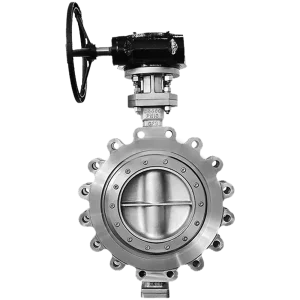
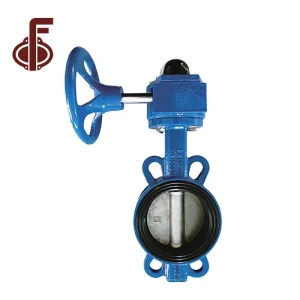
Commercial Status & Industrial Demand for Carbon Steel Valves
Analyzing mechanical properties, global consumption trends, and material suitability of cast steel (ASTM A216 WCB/WCC) across downstream industries.
The Structural Superiority of Carbon Steel in Fluid Control
In modern piping systems, butterfly valves manufactured from carbon steel (principally ASTM A216 Gr. WCB and ASTM A352 LCC for low temperatures) occupy the critical middle-to-high pressure space. Unlike grey iron (CI) or ductile iron (DI)—which are limited by brittle fracture characteristics at elevated temperatures or shock loads—cast carbon steel offers superior tensile strength (min. 485 MPa), yield strength (min. 250 MPa), and excellent ductility.
Global petrochemical refineries, LNG transmission systems, steam generation plants, and district energy utilities rely extensively on carbon steel butterfly valves due to their exceptional thermal expansion stability and resistance to pipe stress vibrations. Triple eccentric (TOV) configurations cast in WCB provide bi-directional zero-leakage isolation even under ASME Class 150, Class 300, and Class 600 pressure envelopes.
- Thermal Stability: Sustains structural integrity across temperatures from -29°C (-20°F) up to +425°C (+800°F).
- High-Pressure Suitability: Seamlessly matches ASME B16.5 and EN 1092-1 flange ratings with minimal wall deformities.
- Firesafe Design: Inherently compatible with API 607 / ISO 10497 firesafe requirements through graphite-laminated sealing rings.
Evolving Global Supply Dynamics & Procurement Drivers
International EPC contractors and plant operators face rising capital expenditure pressures. Valve procurement strategies are transitioning away from heavy, expensive cast steel gate and globe valves toward high-performance double and triple offset carbon steel butterfly valves.
A triple eccentric butterfly valve manufactured in carbon steel provides a 60% to 70% weight reduction compared to a gate valve of the same nominal diameter (DN300–DN2000), drastically reducing structural pipe rack supports, installation footprint, and valve actuation torque requirements. Concurrently, environmental regulations demand valves that comply with ISO 15848-1 and TA-Luft fugitive emission limits, cementing precision-machined carbon steel valve assemblies as the industry standard.
- Reduced Actuation Sizing: Low operational breakaway torque translates to lower pneumatic/electric actuator capex.
- Fugitive Emission Mitigation: Live-loaded PTFE or graphite stem packing ensures micro-leak mitigation for volatile compounds.
- Extended Service Lifecycle: Hardened Stellite® or nickel-plated seating surfaces prevent galling in cycling services.
China OEM Factory Efficiency & Supply Chain Resilience
How state-of-the-art Chinese valve manufacturing ecosystems offer international brands unprecedented scalability, cost efficiency, and metallurgical precision.
Integrated Foundry & CNC Machining
Tier-1 Chinese valve manufacturers in clusters such as Tianjin and Zhejiang operate vertically integrated sand casting, shell moulding, and five-axis CNC machining centers. This eliminates intermediary markups and enables complete dimensional repeatability within tolerances of ±0.02 mm across large batch production runs.
Aggregated Cost & Tooling Economies
With mature local supply webs for raw billets, high-grade fluoropolymers (PTFE/RTFE), elastomer compounding, and specialty bolting (ASTM A193 B7/B7M), OEM clients realize 30% to 45% production cost savings without compromising international testing compliance or alloy purity.
Rigorous Metallurgical Traceability
Certified Chinese OEM factories provide complete EN 10204 Type 3.1 material test certificates (MTCs), optical emission spectrometry (OES) chemical validation, Charpy V-notch impact tests, and non-destructive examination (NDE) including Radiographic (RT), Ultrasonic (UT), and Magnetic Particle (MT) testing.
Rapid Prototype-to-Assembly Agility
Leveraging in-house CAD/FEA simulation, custom tooling for large-diameter carbon steel bodies (up to DN2400 / 96-inch) is achieved in half the standard Western lead time. Modular assembly stations and multi-station hydro-test benches shorten container turnaround to 30–45 calendar days.
Material Specifications & Design Criteria for Carbon Steel Valves
Comparative reference guide for mechanical engineers, piping designers, and procurement managers specifying industrial valves.
| Component | Standard Material (WCB) | Alternative Alloys (Low-Temp / High-Strength) | Engineering Compliance Standards |
|---|---|---|---|
| Valve Body | ASTM A216 Gr. WCB (Normalized) | ASTM A352 LCC / LCB, ASTM A216 WCC, A105 Forged | ASME B16.34, API 609, EN 12516, BS EN 593 |
| Disc | WCB + Ni Plating / CF8 / CF8M | Super Duplex (2507), Monel K500, Hastelloy C276 | API 609, DIN 3840, JIS B2032 |
| Stem / Shaft | ASTM A564 Type 630 (17-4PH) | SS316, SS410, SS420, Inconel 718 | API 609 Blow-out Proof Stem Verification |
| Seat / Sealing Ring | SS316 + Flexible Graphite Laminate | Solid Stellite® 21, Inconel 625, PTFE / RPTFE | API 598 (Zero Leakage Rate A), ISO 5208 Rate A |
| Flange Face | Smooth Finish (Ra 3.2 - 6.3 µm) | Serrated Concentric / Spiral (Ra 6.3 - 12.5 µm) | ASME B16.5, ASME B16.47 Series A/B, EN 1092-1 |
Industrial Application Scenarios & Operating Environments
Engineered for high stress, thermal variation, and non-corrosive to mildly aggressive hydrocarbon and water systems.
Power Generation & District Steam
Applied in main steam extraction, boiler feedwater control, and cooling tower circulating lines. Cast carbon steel resists thermal cycling without suffering brittle deformation, pairing with metal-to-metal laminated seal rings for Class IV and Class VI shutoff at saturated steam conditions.
Refining, Hydrocarbons & Petrochemical
Installed on crude distillation, catalytic cracking isolation, and fuel storage transfer manifold stations. The heavy-duty WCB body construction absorbs pipeline stress shocks while providing firesafe isolation compliant with API 607.
Municipal Water & Desalination Transmission
Large-diameter AWWA C504 and BS EN 593 double-eccentric carbon steel valves serve in high-head pumped aqueducts, raw water intake penstocks, and reverse osmosis plants where operating pressures exceed the ductile iron safety threshold.
Marine Cargo Handling & Off-Shore Skids
Compact wafer and lug carbon steel valves are integrated into FPSO ballast manifolds, fire-main distribution grids, and cargo oil piping, offering certified Lloyd's / DNV-GL compliance with minimal space and top-deck structural load.
Industry Trends & What Global Procurement Teams Demand
From smart actuation interfaces to hydrogen-ready metallurgy, examine how OEM valve manufacturers adapt to 2026+ procurement specifications.
Digital Actuation & Smart Valve Positioners
Procurement engineers rarely purchase standalone manual gear valves today. ISO 5211 direct-mount actuation pads are precision-machined as standard on carbon steel bodies, allowing seamless pairing with Modbus, Profibus, and Foundation Fieldbus-enabled intelligent pneumatic and multi-turn electric actuators.
Decarbonization, CCUS & Hydrogen Blending
Carbon capture, utilization, and storage (CCUS) and hydrogen transport lines require ultra-dense castings without micro-porosity. Leading factories deploy advanced vacuum degassing during melting and complete helium mass spectrometer leakage testing down to 1x10⁻⁶ mbar·L/s.
Standardization of Fugitive Emission Control
Driven by ESG mandates and environmental regulatory fines, global EPC buyers now enforce ISO 15848-1 Class BH / AH verification. Carbon steel butterfly valves feature dual O-ring safety backups, Belleville spring-energized packing, and polished stem finishes (Ra ≤ 0.4 µm) to prevent microscopic VOC venting.
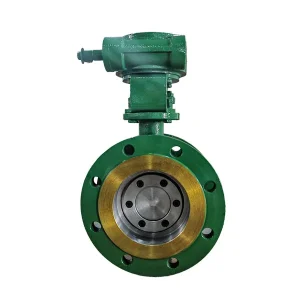
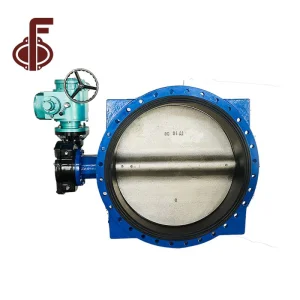
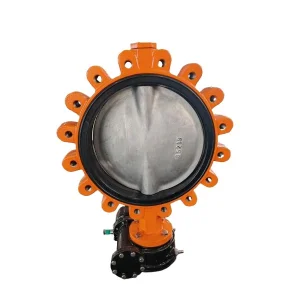
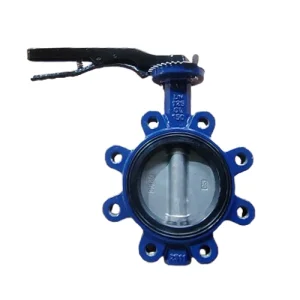
High-Performance OEM Valve Configurations (Series 2)
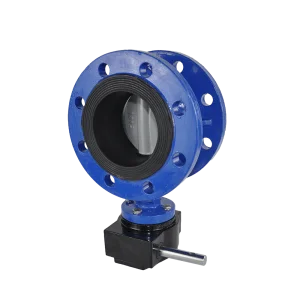
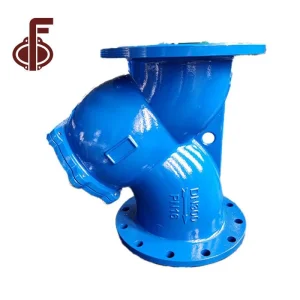
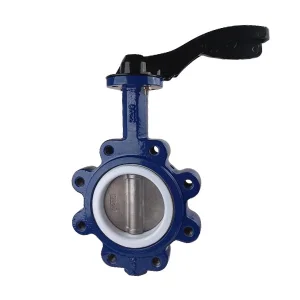
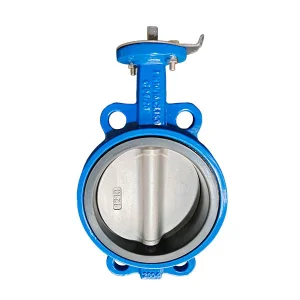
Continuous industrial supply featuring high-performance double flanged, stainless-trimmed, and versatile multi-standard assemblies.
How Global Engineering Teams Audit an OEM Butterfly Valve Factory
A non-compromising 5-point factory acceptance testing (FAT) verification guide for quality engineers and procurement specialists.
1. Chemical & Mechanical Heat Verification
Verify that furnace heat batch codes are permanently cast or hard-stamped on every body and disc. Correlate with EN 10204 3.1 MTCs showing exact Carbon (≤ 0.30%), Manganese (≤ 1.00%), Phosphorus (≤ 0.04%), and Sulfur (≤ 0.045%) composition.
2. Hydrostatic Shell & Seat Tightness
Conduct pressure tests according to API 598 or ISO 5208. The shell test pressure must equal 1.5x the cold working pressure (CWP), held for a minimum of 60 to 180 seconds depending on nominal valve size without visible leakage or structural sweating.
3. Breakaway Torque & Cycle Verification
Measure dynamic operating torque under maximum differential pressure (ΔP). Confirm that torque signatures remain within calculated limits (±10%) to protect downstream actuation packages from over-torque damage during emergency shutdowns.
4. Surface Protection & Anti-Corrosion Coating
Verify body grit blasting to Sa 2.5 profile followed by high-solid epoxy painting (≥ 250 µm thickness) or fusion bonded epoxy (FBE) coating. Check for absence of pinholes via holiday detection testing at 1.5 kV to prevent atmospheric rust during sea transit.
Frequently Asked Questions: Carbon Steel Butterfly Valves
Authoritative technical and procurement insights addressing metallurgical, structural, and OEM sourcing questions.
What is the difference between ASTM A216 WCB and WCC in butterfly valve construction?
Both ASTM A216 WCB and WCC are cast carbon steel grades suitable for high-temperature and pressure service. WCB is the most universally specified grade with a maximum carbon content of 0.30%, yield strength of 250 MPa, and tensile strength of 485–655 MPa. WCC has slightly higher allowable carbon (0.25% with maximum carbon equivalent formulas) and delivers higher mechanical strength: minimum yield strength of 275 MPa and tensile strength of 485–725 MPa. WCC is frequently specified by European and Middle Eastern EPC contractors when slightly higher allowable flange stress limits are required at design pressures.
When should engineers choose a Triple Offset Butterfly Valve over a concentric or double offset valve?
Triple offset butterfly valves (TOVs) are engineered for critical applications where soft-seated (EPDM/NBR/PTFE) concentric or high-performance double eccentric valves cannot survive. TOVs feature three distinct geometric offsets: the shaft offset behind the seat plane, the shaft offset eccentric to the pipe center, and a conical seat angle offset. This unique geometry allows the disc to cam into the seat with zero rubbing or friction until final mechanical wedging. TOVs with carbon steel WCB bodies and stainless/graphite laminated seats are mandatory for temperatures exceeding 200°C, high-pressure steam, severe hydrocarbons, and applications requiring API 607 firesafe compliance with bi-directional zero-leakage shutoff.
Can carbon steel butterfly valves be used in cryogenic or low-temperature services?
Standard ASTM A216 WCB is restricted to an operational lower temperature threshold of -29°C (-20°F) due to ductile-to-brittle transition phenomena. For temperatures below -29°C down to -46°C (-50°F), OEM factories utilize ASTM A352 LCC or LCB low-temperature carbon steel, which undergoes mandatory Charpy V-notch impact testing at low temperatures. For cryogenic services below -46°C down to -196°C (liquid nitrogen/LNG), austenitic stainless steels (such as ASTM A351 CF8M) with extended bonnet designs must be utilized instead of carbon steel.
What OEM branding and custom marking options are supported by the factory?
A full-capability OEM factory provides custom pattern casting of your brand logo directly onto the carbon steel valve body shell, along with customized 316 stainless steel nameplates stamped with your model numbers, pressure classes, serial tracking codes, and QR codes for digital asset management. Furthermore, custom paint color palettes (RAL/Pantone specs for plant identification), tailored end-flange drillings (ASME/DIN/JIS dual-standard compatibility), and client-branded export seaworthy plywood crating are fully supported.
How does a carbon steel butterfly valve achieve API 607 Firesafe Certification?
Firesafe certification to API 607 / ISO 10497 certifies that during and after exposure to a fire environment of 750°C–1000°C (1382°F–1832°F) for 30 minutes, internal and external leakage through the valve body, stem packing, and seat stays within strictly defined maximum thresholds. In carbon steel butterfly valves, this is accomplished through fire-resistant flexible graphite stem seals, heavy-duty blow-out proof stems, and metal-to-metal backup sealing mechanisms that engage if primary soft seals burn away.
