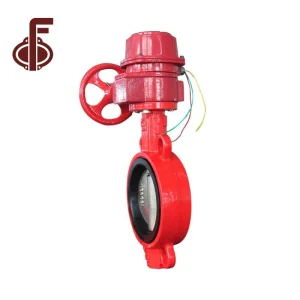
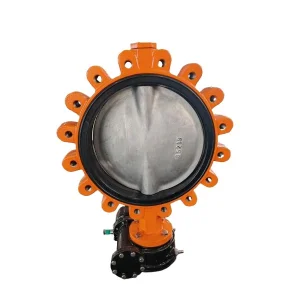
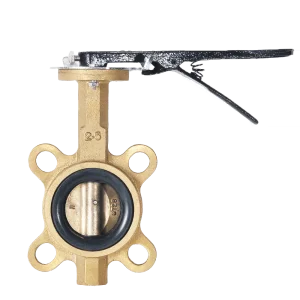
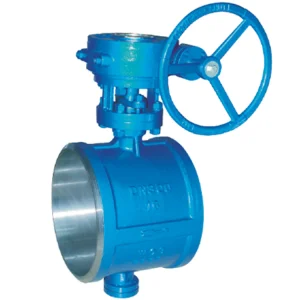
Engineered Butterfly Valves & Flow Control Components
Explore our export-ready industrial valves, manufactured under stringent DIN, ANSI, and ISO tolerances for mission-critical operations.
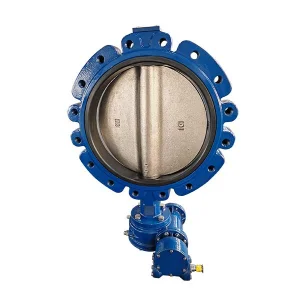
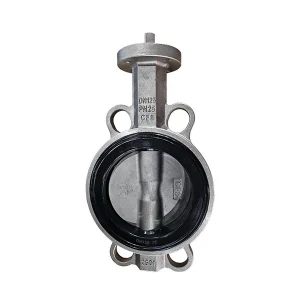
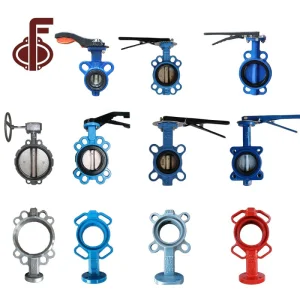
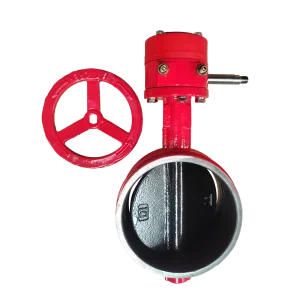
Engineering Geometry: Mechanics of Triple Offset Lug Valves
A comprehensive examination of how three geometric offsets eliminate friction, prevent seat wear, and deliver bi-directional bubble-tight sealing.
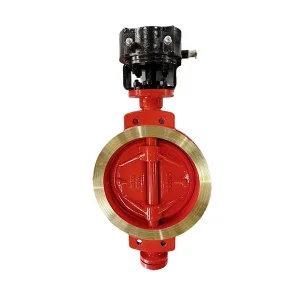
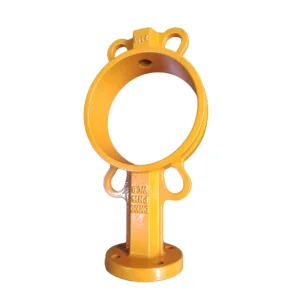
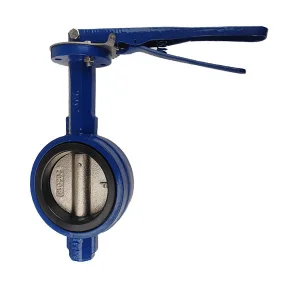
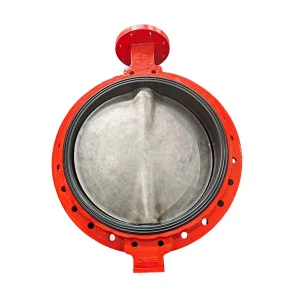
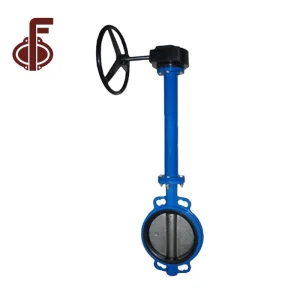
In modern industrial fluid dynamics, isolating aggressive media under volatile thermal gradients requires an evolution beyond standard resilient-seated or double-eccentric configurations. The Triple Offset Butterfly Valve (TOV / TOBV) Lug Type represents the pinnacle of rotary valve engineering. Built with a full-lug body geometry featuring tapped holes according to ANSI B16.5, DIN EN 1092-1, or JIS B2238, this valve is purpose-designed for bidirectional dead-end isolation and high-frequency throttling service.
Offset 1: Shaft Displacement
The shaft axis is placed downstream behind the sealing plane. This displacement enables uninterrupted 360-degree contact across the entire sealing perimeter, removing split-sealing vulnerability common in concentric configurations.
Offset 2: Pipe Center Eccentricity
The stem center is offset laterally from the pipe centerline. During actuation, this allows the disc profile to immediately peel away from the seat within the first few degrees of opening, virtually eliminating mechanical friction.
Offset 3: Conical Axis Inclination
The cone angle axis of the seat and seal ring is angled obliquely to the pipeline axis. This creates a distinct camming action that ensures contact is only achieved at the final millimeter of shut-off, realizing frictionless torque seating.
China OEM Valve Manufacturing Competence
Combining heavy metallurgical casting, 5-axis CNC machining centers, and automated hydrostatic testing to support global EPC projects.
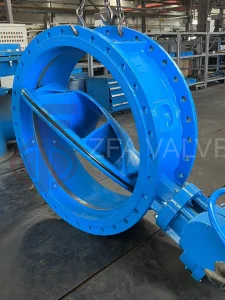
China’s advanced industrial manufacturing ecosystem has transitioned from simple labor arbitrage into high-integrity technological integration. In our Tianjin facility, complete supply chain control over foundries, alloy spectrographic analysis, and CNC tooling enables precision machining of elliptical laminated seats (Duplex 2205 + Flexible Graphite / Inconel 625 + PTFE) with micro-tolerances within ±0.005mm.
Triple Offset Butterfly Valve Lug Engineering Matrix
Standardized metallurgical combinations, dimensional conformity, and fire-safe integrity parameters.
| Design Parameter | Standard Compliance | Material / Technical Option | Engineering Benefit |
|---|---|---|---|
| Nominal Size Range | ASME B16.10, API 609 Cat. B | DN50 – DN1800 (NPS 2" – 72") | Full pipeline scalability across small to giant transmission headers |
| Pressure Rating | ASME B16.34, EN 12516 | Class 150, Class 300, Class 600 (PN10 – PN100) | High-pressure containment for extreme petrochemical applications |
| Body & Lug Construction | ASTM A216, A351, A890 | WCB, LCC, CF8M, CF3M, Duplex 2205, Super Duplex 2507 | High tensile strength; tapped threaded lugs allow downstream piping disassembly |
| Disc Seal Ring | API 607 7th Edition | Multi-layer SS316 + Flexible Graphite / Stellite No.6 Hardfaced | Fire-safe certified; remains bubble-tight during and after thermal shock |
| Stem Retention | API 609 / ISO 15848-1 | Anti-Blowout One-Piece Shaft with TA-Luft certified packing | Fugitive emission prevention; operator safety against operational surge |
| Leakage Rate | API 598, ISO 5208, ANSI/FCI 70-2 | Zero Leakage / Rate A / Class VI | Hermetic sealing under high differential pressure and cryogenic temperatures |
Mission-Critical Industry Solutions
Engineered to replace cumbersome gate valves and high-maintenance ball valves in critical infrastructure projects.
LNG & Cryogenic Gas Handling
Operates reliably at -196°C using extended bonnet designs with vapor columns. Stellite-treated seats resist thermal shrinkage and maintain molecular gas tightness for LNG liquefaction terminals.
Refining & Hydrocarbon Processing
Immune to catalyst cracking coking and sulfur corrosion. The non-rubbing lug triple offset architecture stops galling in hydrotreater units and delayed cockers operating above 550°C.
Superheated Steam & Power Generation
Replaces heavy cast steel gate valves in supercritical power plants. Lug triple eccentric valves reduce pipeline structural weight by up to 70% while offering rapid 90-degree rotary shutdown.
Desalination & Seawater Brine
Utilizing high-alloy Duplex and Nickel-Aluminum Bronze bodies, our lug valves resist pitting and crevice corrosion under high hydrostatic discharge pressures on reverse osmosis (RO) headers.
District Energy & Geothermal
Engineered for cyclic district heating and cooling (DHC) loops. Resists thermal cycling stress and silica scaling in geothermal fluid loops where ordinary elastomer seals degrade.
Automated Skid Manufacturing
Features an ISO 5211 direct-mount top flange that integrates seamlessly with pneumatic scotch-yoke or multi-turn electric actuators for automated ESD (Emergency Shutdown) systems.
Strategic OEM Procurement: China Direct Advantage
Why Tier-1 international valve brands, EPC contractors, and pipeline distributors partner with ZFA Valve.
Material Traceability
Full EN 10204 3.1 certification provided with every shipment. Complete chemical heat numbers, mechanical impact testing, and PMI testing prevent alloy mix-ups.
Custom Engineering
Full OEM private labeling, custom drilling patterns (ASME, DIN, BS), customized stem extensions, and exotic alloys (Hastelloy, Monel) crafted directly from CAD models.
Streamlined Logistics
Located in Tianjin, North China's maritime transport hub, delivering rapid container staging, ocean freight consolidation, and safe seaworthy fumigated packaging.
Quality Assured
Every single valve undergoes double-block pressure verification, shell testing at 1.5x nominal pressure, and seat tightness testing at 1.1x pressure before crating.
Technological Frontiers: The Evolution of Triple Offset Valves
Market drivers reshaping high-performance flow containment over the next decade.
The industrial valve sector is undergoing rapid transformation fueled by net-zero carbon initiatives, stringent fugitive emissions regulations, and the global ramp-up of the green hydrogen and carbon capture (CCUS) value chains. Modern triple offset lug butterfly valves are moving to the forefront of this shift because of their inherently compact footprint, zero continuous emissions, and non-rubbing architecture.
Fugitive Emission Containment
With environmental mandates tightening via ISO 15848-1 and EPA Method 21, packing glands now utilize live-loaded Belleville springs combined with ultra-pure braided carbon rings to ensure emissions stay under 50 ppmv across 100,000 cycles.
Hydrogen & CCUS Service
Supercritical CO2 transport and hydrogen storage demand non-porous valve casings. Our investment casting and vacuum degassing processes prevent micro-porosity, mitigating hydrogen embrittlement across critical high-pressure stages.
Smart Digital Integration
ZFA incorporates smart IoT partial stroke testing (PST) digital positioners directly onto the ISO 5211 bracket. This provides plant maintenance teams with continuous real-time torque analytics and predictive maintenance warnings.
Frequently Asked Questions on Triple Offset Lug Valves
Expert answers addressing the selection, procurement, installation, and engineering integrity of our product lines.
Why choose a Lug body design over a Wafer body design for a Triple Offset Valve?
Lug body triple eccentric butterfly valves feature full drilled and tapped threaded holes across both bolt circles. This permits downstream pipeline disconnection while maintaining full line pressure upstream (dead-end isolation service). In contrast, wafer valves are sandwiched between flanges via long through-bolts and cannot maintain isolation if one pipe segment is dismantled for pump or meter maintenance.
How does a Triple Offset Valve achieve true Zero Leakage?
Traditional valves rely on rubber interference or uniform sphere rubbing that degrades with continuous cycle frequency. The triple offset design features an angled conical seal axis where the seal ring and body seat meet only at final shut-off without mechanical rubbing. Sealing is energized directly by the actuator torque pushing the flexible stainless/graphite laminated disc ring against the conical body seat, achieving API 598 zero bubble leakage.
What international design and manufacturing standards do ZFA valves comply with?
Our OEM valve lines are engineered and verified according to ASTM, ANSI/ASME (B16.34, B16.10, B16.5), ISO (ISO 5208, ISO 9001, ISO 5211), API (API 609, API 598, API 607 Fire-Safe), BS, DIN, GOST, JIS, and KS standards, ensuring drop-in compatibility across international industrial hubs.
What is the difference between laminated seats and solid metal seats?
Laminated seats utilize alternating sheets of stainless steel and expanded graphite, allowing micro-flexibility under torque to achieve bubble-tight zero leakage in temperatures from -196°C up to 450°C. Solid metal seats (typically hardfaced with Stellite) are specified for severe high-abrasion slurries or extreme temperatures exceeding 600°C where elastomer or graphite would degrade, providing robust Class V or Rate B shut-off.
Can Triple Offset Lug Butterfly Valves replace Gate Valves and Ball Valves?
Yes. TOVs offer substantial advantages over gate valves, including up to 70% lower weight, a compact face-to-face envelope, frictionless rotary 90-degree actuation (reducing actuator power requirements), and significantly reduced fugitive emissions. They are also superior to large-bore metal-seated ball valves in capital cost, ease of seat replacement, and lower torque requirements.
What OEM and custom manufacturing capabilities does Tianjin Zhongfa Valve support?
We provide comprehensive OEM partnership services including customized casting patterns, bespoke stem keyway dimensions, direct actuation brackets (ISO 5211), custom coating systems (anti-corrosive epoxy, thermal spray aluminum), non-destructive testing (PT, MT, RT, UT), private labeling/tagging, and worldwide project documentation packs.
Specialized Industrial Valves & Severe Service Series
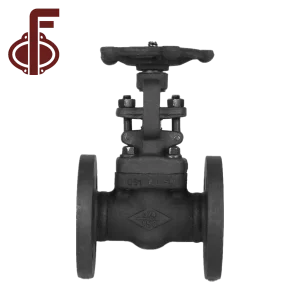
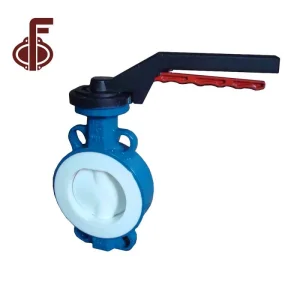
Precision-cast gate, wafer, double eccentric, and triple offset valves for global chemical, municipal, and energy plants.