
Featured Industrial Flow Control Lineup
Engineered and calibrated at our Tianjin facility to meet ASTM, ANSI, DIN, and ISO standards for municipal, HVAC, marine, and extreme chemical process lines.
The Evolutionary Mechanics of Eccentric Flow Control
A rigorous engineering comparison of concentric, high-performance double offset, and triple eccentric rotary isolation valves under extreme operational duty.
Concentric (Zero Offset)
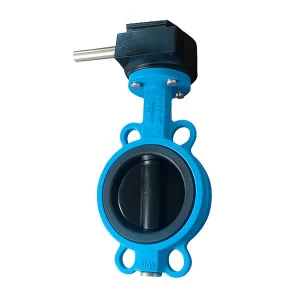
The stem traverses directly through the geometric center of both the valve disc and seat liner. Sealing depends strictly on continuous mechanical interference throughout the entire 90° rotational arc. While ideal for cost-sensitive low-pressure water systems (PN10/PN16), continuous elastomeric friction generates elevated operating torque, accelerated seat hysteresis, and localized wear at the upper and lower stem journals.
Double Eccentric (High Performance)
Offset 1 positions the shaft axis behind the sealing plane; Offset 2 offsets the shaft laterally from the pipeline centerline. This dual-offset camming geometry allows the disc to lift cleanly away from the seat within the first 1-3 degrees of opening rotation. Frictional contact is virtually eliminated during cycling, reducing actuator sizing requirements by up to 35% and extending polymer (PTFE/RPTFE) seat service life beyond 100,000 cycles.
Triple Eccentric (Metal-to-Metal TOV)
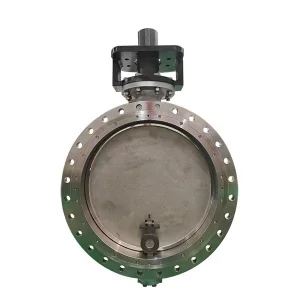
Offset 3 introduces an inclined conical sealing angle, machining the contact axis into a non-symmetric ellipse. The disc engages the seat purely via torque-seated wedging action with zero rubbing or scuffing across the entire stroke. This delivers certified bi-directional bubble-tight shutoff (API 598 zero leakage) across thermal extremes from cryogenic LNG (-196°C) to superheated refining media (+815°C) at ASME Class 150 to 900.
In high-differential pressure liquid throttle scenarios, modern eccentric designs utilize specialized anti-cavitation trim profiles. Operating near the critical cavitation index (σ < 1.5) generates localized micro-jets capable of pitting standard WCB carbon steel. By specifying hardened Stellite No. 6 disc edge deposition alongside specialized parabolic flow tabs, our factory mitigates destructive cavitation recovery across intermediate angles (30° to 70° disc opening).
Global Procurement Intent: Navigating TCO, Standards & Compliance
Critical benchmarks utilized by multinational procurement directors, plant engineers, and EPC contractors to evaluate Chinese valve manufacturing partners.
API 609 Category B & ASME B16.34
Global refinery and energy infrastructure tenders mandate rigorous compliance with API 609 Cat B face-to-face dimensions and wall thickness formulas dictated by ASME B16.34. Verification requires detailed finite element stress calculations (FEA) proving body shell integrity under simultaneous internal pressure spikes and external pipe bending moments.
Fugitive Emissions: ISO 15848-1 Class AH
With environmental regulatory enforcement intensifying worldwide (EPA Method 21 and European Industrial Emissions Directives), stem packing leakage is zero-tolerance. ZFA integrates live-loaded cup-and-cone graphite packing arrangements alongside precision ground stem finishes (Ra ≤ 0.2 μm) to achieve helium sniffing test pass rates under ISO 15848-1 tightness Class AH.
SIL 3 Functional Safety Certification
For automated emergency shutdown (ESD) and safety instrumented systems (SIS), procurement specifications demand proven PFDavg (Probability of Failure on Demand) data. Our quarter-turn assemblies undergo extensive cyclotesting and failure mode effects diagnostic analyses (FMEDA), guaranteeing seamless integration into SIL 2 and SIL 3 loops.
Fire-Safe Verification: API 607 / ISO 10497
When deployed in flammable liquid or gas services, valve containment must hold fast under external infernos. Our laminated metal-graphite and solid metal seats endure burn tests at 761°C to 1000°C for 30 minutes under active line pressure, demonstrating minimal through-seat and external gland leakage within allowable fire-test limits.
Actuator Sizing & MAST Constraints
A frequent procurement pitfall is mismatching actuator output torque with the valve Maximum Allowable Stem Torque (MAST). Factory engineering sheets supply precise dynamic opening, break, and reseat torque values across varying differential pressures (ΔP), preventing catastrophic stem shear during high-velocity trip events.
Comprehensive Life-Cycle Cost (LCC)
Purchase price represents less than 22% of total operational expenditure over a 20-year span. Replacing high-maintenance ball or gate valves with high-performance double or triple offset butterfly valves reduces pipe bridge structural support requirements due to compact face-to-face dimensions and cut unit mass by 60%.
China Factory 4.0: Supply Chain Depth, Metallurgy & Efficiency
How the northern industrial ecosystem in Tianjin integrates robotic machining, precision casting foundries, and automated inspection to dominate global supply chains.
Foundry Integrity & Spectrometric PMI
Casting porosity and tramp elements ruin valve longevity. Our foundry lines implement induction melting coupled with Argon Oxygen Decarburization (AOD) refining. Every melt heat undergoes direct-reading Optical Emission Spectroscopy (OES) alongside Positive Material Identification (PMI) to guarantee strict carbon control (C ≤ 0.03% in 316L/CF3M) and optimal ferrite percentages.
Automated Robotic Stellite Hardfacing
For triple eccentric high-pressure bodies, manual stick welding creates uneven thermal stress and micro-fissuring. ZFA utilizes robotic Plasma Transferred Arc (PTA) welding to deposit homogeneous Stellite Grade 6 and Grade 21 cobalt-chromium overlays onto valve seats. This creates an ultra-tough sealing profile (HRC 42-48) capable of resisting severe erosive slurry impact.
Supply Chain Proximity & Freight Velocity
Located in Tianjin's industrial corridor, our facilities enjoy instant physical access to one of Asia's premier deep-water shipping terminals. Proximity to local steel mills, rubber vulcanization plants, and casting facilities slashes material lead times by 40% compared to Western counterparts, allowing delivery of large-bore valves (DN600-DN2000) in project-critical timelines.
Macro Application Profiles: Localized Operating Environments
Engineered to master severe operating conditions across municipal distribution, fossil fuel processing, and decarbonized energy production.
Seawater Desalination (SWRO)
Environment: Ultra-high chloride brines, operating pressures reaching 70 to 85 bar, continuous risk of localized pitting and crevice corrosion.
Engineering Solution: Super Duplex Stainless Steel (2507 / 1.4410) bodies and discs with PTFE or vulcanized hard rubber liners, eliminating galvanic decay across high-pressure membrane feed racks.
District Energy & Geothermal Steam
Environment: Superheated water (140°C to 200°C), thermal cycling, entrapped entrained scale, continuous flow regulation.
Engineering Solution: Carbon steel (WCB) double eccentric valves fitted with flexible metal seats (Inconel 718) and anti-blowout stem retention systems, ensuring leak-free isolation throughout decades of winter heating cycles.
Cryogenic LNG Terminals
Environment: Liquefied Natural Gas boil-off and transfer lines at temperatures dropping to -196°C.
Engineering Solution: Extended-bonnet triple eccentric butterfly valves crafted from ASTM A351 CF8M, featuring gas-column vapor seals that keep packing glands warm, preventing seal freeze-up and uncontrolled methane emissions.
HVAC Hydronics & Smart Data Centers
Environment: 24/7 continuous chilled water loops, hyperscale computing cooling arrays requiring minimal pressure drop (ΔP).
Engineering Solution: Concentric and double eccentric wafer/lug valves configured with aluminum bronze or nylon-coated ductile iron discs and high-resilience EPDM liners for maximum hydraulic coefficient ($C_v$).
Chemical Processing & Corrosive Scrubbers
Environment: Hydrochloric acid, wet chlorine gas, volatile caustic solvents, demanding complete fluid isolation.
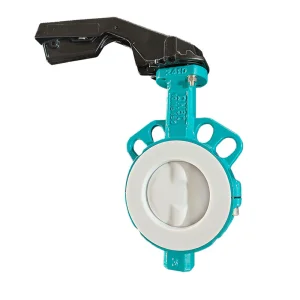
Engineering Solution: PTFE/PFA fully lined butterfly valves with high-density isostatically molded polymer shells (min 3mm thickness), dual-barrier dynamic shaft sealing, and anti-static grounding mechanisms.
Mining Slurry & Tailings Transport
Environment: Highly abrasive quartz ore suspensions, fluctuating pipe velocities, severe mechanical gouging.
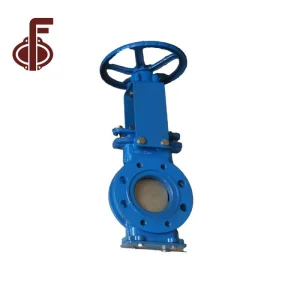
Engineering Solution: Heavy-duty knife gate and specialized rubber-sleeved eccentric rotary valves engineered with replaceable wear rings, ensuring easy inline maintenance without replacing the primary cast body.
Comprehensive Seat & Connection Selection Architecture
Optimize your project specifications with empirical performance boundaries for elastomer, fluoropolymer, and metal-to-metal seating technologies.
| Seat Configuration | Sealing Principle | Standard Material Matrix | Temperature Envelope | Pressure Range | Target Fluid Environments |
|---|---|---|---|---|---|
| Resilient Soft Seat | Elastomeric compression interference | EPDM, NBR, FKM (Viton), Neoprene | -20°C to +135°C | PN6 to PN25 (Class 150) | Potable water, raw wastewater, fire mains, HVAC condenser water, compressed air. |
| High-Performance Polymer | Mechanical deflection with back-up energizer | Virgin PTFE, RPTFE (Glass/Carbon filled), PEEK | -40°C to +230°C | PN10 to PN50 (Class 150/300) | Hydrocarbons, corrosive acids, alkalis, vacuum distillation, pharmaceutical slurries. |
| Laminated Seal Ring | Torque-seated metal/graphite lamellae wedge | SS316 / Duplex + Flexible Graphite (Graphoil) | -196°C to +450°C | ASME Class 150 to 600 | High-temperature steam, thermal oil, flare systems, hydrocarbon cracking, refining. |
| Solid Metal-to-Metal | Non-rubbing Stellite hardfaced conical wedge | Solid CF8M / WCB with Stellite 6 / 21 deposition | -196°C to +815°C | ASME Class 150 to 900 | Abrasive catalyst fines, power plant feedwater, molten salts, blast furnace gas. |
Wafer End Connection
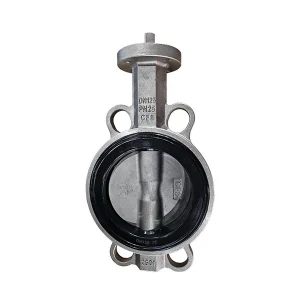
Features a slender, lightweight body positioned between pipe flanges using continuous through-studs. Lowest freight and initial purchasing cost; however, it cannot be employed for pipe dead-end service without specialized downstream retaining plates.
Lug End Connection
Equipped with threaded, drilled lugs aligned directly with ANSI or DIN flange bolt patterns. Enables independent downstream piping removal for equipment servicing while maintaining line pressure upstream under dead-end conditions.
Double Flanged Connection
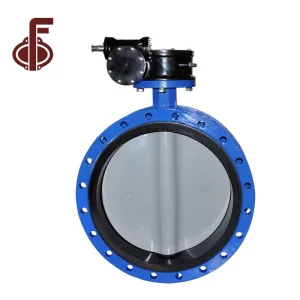
Integral raised-face (RF) flanges on both ends designed strictly to ASME B16.5 / EN 1092-1. Delivers maximum structural rigidity, eliminates pipe shear stress transfer to internal valve components, and represents the industry standard for large-bore lines > DN600.
Rigorous Inspection, FAT Testing & Auditing Framework
Transparency from raw melt ingot to boxed export crating: how our quality management structure defends project uptime.
100% Shell & Seat Hydrostatic Proofing
Every single valve undergoes pressure testing per API 598 and EN 12266-1. Shell testing at 1.5× cold working pressure (CWP) validates structural casting density. High-pressure liquid and low-pressure pneumatic seat testing (at 1.1× and 0.6 bar, respectively) confirms zero-bubble performance before signoff.
Non-Destructive Examination (NDE)
Castings slated for lethal, toxic, or high-pressure gas service undergo rigorous NDE testing. Radiographic Testing (RT) isolates internal gas voids; Ultrasonic Testing (UT) inspects stem bar stock integrity; Dye Penetrant (PT) and Magnetic Particle (MT) inspect machined weld overlays for micro-cracks.
EN 10204 3.1 Traceable Mill Certificates
Complete traceability is anchored in our ERP inventory system. Each valve carries a unique laser-engraved stainless steel nameplate keyed to comprehensive 3.1 chemical analysis, mechanical tensile and elongation figures, Charpy V-notch impact test values, and hydrostatic test charts.
Engineering Q&A: Technical Procurement Inquiries
Direct technical answers to the most critical mechanical, operational, and sourcing questions raised by valve application engineers.
What exact geometric advantages distinguish double eccentric from triple eccentric butterfly valves?
Can eccentric butterfly valves provide reliable bi-directional shutoff under full rated differential pressure?
How does actuator sizing differ between concentric and eccentric butterfly valves?
What failure modes occur when using standard butterfly valves in throttling or control service?
What surface treatments and metallurgy are recommended for offshore or marine environments?
How does ZFA Valve manage OEM customization for international brand owners?
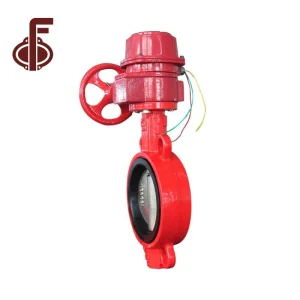
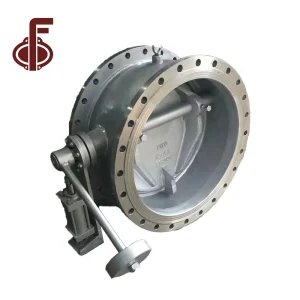
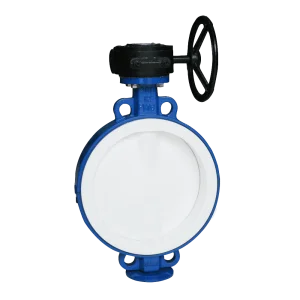
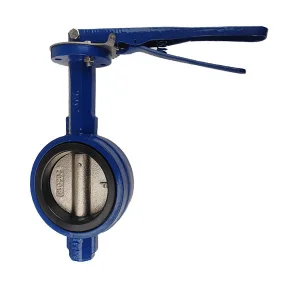
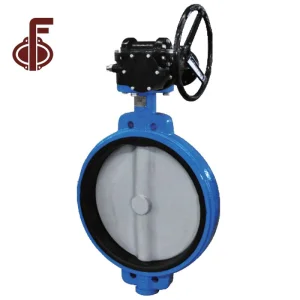
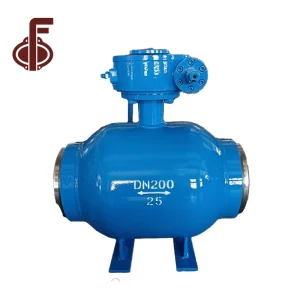
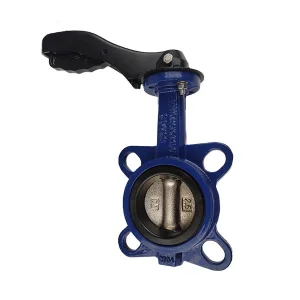
Specialized Heavy Industrial & Fire Protection Series
Explore high-torque actuated solutions, fire-signaled security valves, hard-back seat technologies, and fully welded steel configurations.
Direct Factory Technical Engagement
Connect directly with our valve engineering desk in Tianjin for sizing calculations, 3D STEP models, material test reports, or tender project quotations.
Direct Engineering Hotline
Telephone consultation with dedicated application specialists.
+86 176 0227 9258Instant Messaging / WhatsApp
Fast dispatch of video audits, foundry photos, and stock updates.
Chat with Valve Engineer