
Precision Flow Systems: Core Valve Range (Part I)
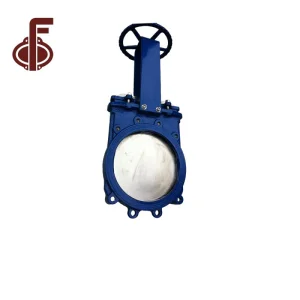
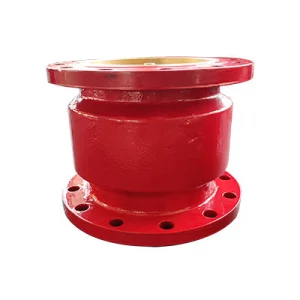
Explore heavy-duty butterfly valves, resilient knife gates, and silent non-return check valves engineered for severe service isolation and modulating duties.
Executive White Paper: Industrial Butterfly Valve Manufacturing in China
As global infrastructure networks, thermal and district cooling installations, chemical processing lines, and municipal desalination complexes scale in capacity and operating pressure, the demand for highly reliable, bi-directional, and zero-leakage flow isolation devices has elevated the butterfly valve from a general utility device to a mission-critical engineering component. Originating as a compact alternative to massive gate and globe valves, modern butterfly valve topologies—encompassing concentric resilient-seated, double eccentric high-performance, and triple eccentric (TOV) metal-seated designs—command unmatched structural advantages: minimal face-to-face dimensions, rapid quarter-turn actuation, reduced weight load on piping supports, and superior hydraulic flow coefficients (Cv values).
Tianjin Zhongfa Valve Co., Ltd. (ZFA Valve), established in 2006 in the manufacturing hub of Tianjin, China, functions at the cutting edge of industrial flow control. Anchored by stringent ISO 9001 quality systems and European CE marking credentials, ZFA Valve bridges world-class precision metallurgical engineering with agile OEM/ODM manufacturing agility. Whether navigating aggressive corrosive chemicals, ultra-pure municipal drinking water, high-velocity chilled water loops, or abrasive marine slurries, global procurement managers, EPC contractors, and system integrators rely on Chinese valve manufacturing hubs for cost optimization, metallurgical consistency, and rigorous adherence to international standards.
Structural Classifications: Types of Butterfly Valves
Selecting the optimal valve architecture requires an intimate technical evaluation of fluid kinematics, operating temperatures, chemical reactivity, and pipeline geometry.
Concentric Resilient-Seated
The stem is centered precisely in the middle of the disc and the bore. Relies on mechanical interference between the spherical disc edge and an elastomeric liner (EPDM, NBR, Viton).
- Nominal Pressures: PN10, PN16, ANSI Class 150
- Bi-directional zero bubble-tight shutoff
- Applications: HVAC, Potable Water, Fire Protection
- Low initial torque, self-centering disc
Double Eccentric (High-Performance)
Features two separate axis offsets: shaft behind the sealing plane and shaft off-center from the bore centerline. Disc cams off the seat immediately upon opening, mitigating seat friction.
- Pressure Classes: Class 150 to Class 300 / PN25-PN40
- Seats: Virgin PTFE, R-PTFE, or flexible metal
- Ideal for steam isolation, pulp & paper, oil refineries
- Extended seat lifespan over concentric models
Triple Eccentric / Triple Offset (TOV)
Integrates a third geometric angular conical offset. Achieves pure rolling contact without friction, yielding metal-to-metal seating capable of extreme thermal and cryogenic duties.
- Ratings: ANSI Class 150 to Class 600 / PN100
- Fire-safe zero leakage to API 607 / ISO 10497
- Temperatures: -196°C (LNG) up to +600°C (Power/Steam)
- Laminated Stellite or Inconel seal rings
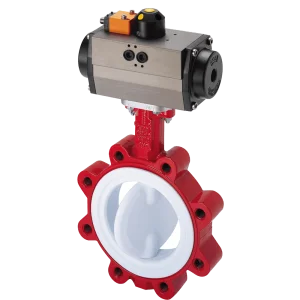
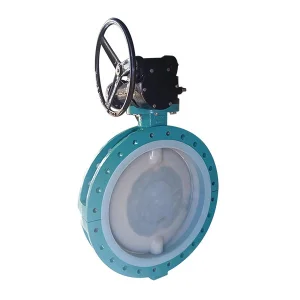
Fully Lined Fluoropolymer (PTFE/PFA)
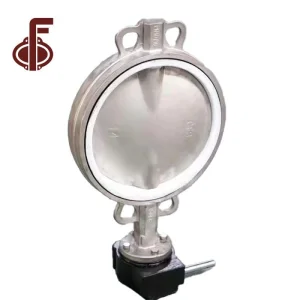
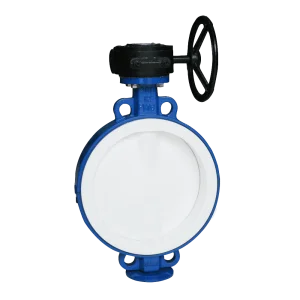
Engineered for hyper-corrosive chemical services where conventional metallurgy corrodes rapidly. The ductile iron or carbon steel housing is fully shielded with 3mm+ thick PTFE or molded PFA.
- Inert to concentrated sulfuric acid, nitric acid, chlor-alkali
- Disc encapsulated in PFA/FEP with silicone cushion
- Dielectric spark tested at 15kV to prevent pinhole voids
- Sanitary compatibility for pharmaceuticals & ultra-pure media
Body End Connections: Wafer, Lug & Flange
Body geometries dictate piping integrity, system weight, and maintenance versatility during pipeline overhaul or pump changeouts.
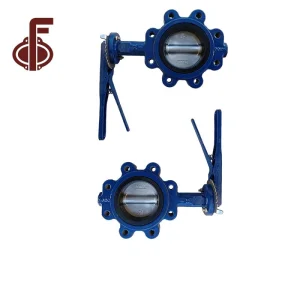
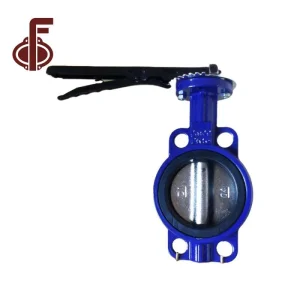
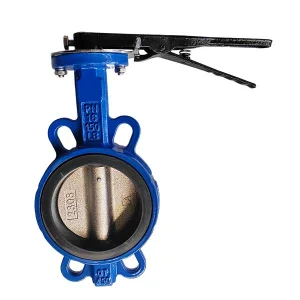
- Wafer: Ultra-compact, clamped between mating flanges
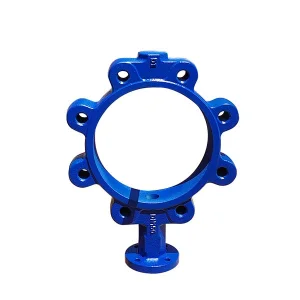
- Lug: Threaded tapped lugs, ideal for dead-end terminal service
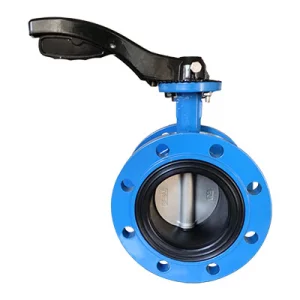
- Double Flanged: Integral dual bolt circles for large diameters
- U-Type Flanged: Lightweight flanged hybrid for large bore lines
Actuation & Automated Control Packages
ZFA valves integrate precision ISO 5211 direct-mount top flanges accommodating electric rotary multi-turn actuators, pneumatic rack-and-pinion cylinders, or worm gear operators.
- Standard ISO 5211 pad for bolt-on bracketless automation
- 4-20mA modulating positioners for throttling duty
- Emergency fail-safe spring return pneumatic actuators
- IP67 / IP68 explosion-proof ATEX enclosures
Disc Metallurgy & Elastomeric Seat Compatibility
A comprehensive engineering cross-reference detailing operating temperature limits, fluid dynamics, and chemical resistance profiles for valve components.
| Component Category | Material Designation | Operational Temperature | Compatible Media Profiles | Typical Industrial Sectors |
|---|---|---|---|---|
| Resilient Seat | EPDM (Food Grade / High Temp) | -20°C to +120°C | Potable water, treated sewage, low-pressure steam, glycols, sea water | Municipal Water, HVAC, District Cooling |
| Resilient Seat | NBR (Nitrile Butadiene) | -10°C to +82°C | Petroleum oils, hydraulic fluids, diesel fuel, compressed air, light hydrocarbons | Oil & Gas Skids, Marine Bunkering, Mining |
| Resilient Seat | Viton / FKM (Fluoroelastomer) | -15°C to +200°C | Concentrated acids, aromatic hydrocarbons, bio-fuels, chlorinated solvents | Petrochemical Refining, Chemical Transfer |
| Engineered Polymer | PTFE / R-PTFE / PFA | -30°C to +180°C | Extreme acids, bleach solutions, high-purity microelectronics fluids | Semiconductor, Pharma, Chlor-Alkali |
| Body & Disc Metal | Ductile Iron (GGG40 / GGG50 / QT450) | -10°C to +300°C | Non-corrosive liquids, civil utilities, chilled and hot cooling circuits | Waterworks, Infrastructure, Fire Mains |
| Body & Disc Metal | Stainless Steel (SS304 / CF8 & SS316 / CF8M) | -196°C to +500°C | Corrosive industrial chemicals, demineralized water, food-grade slurries | Desalination, Marine Engineering, Food & Beverage |
| Specialty Alloys | Aluminium Bronze (C95800 / C95400) | -50°C to +260°C | High-velocity seawater, brackish brine, marine bio-fouling environments | Offshore Platforms, Naval Vessels, Desalination |
| Severe Service Metal | Hastelloy C276 / Super Duplex 2507 | -196°C to +650°C | Wet chlorine gas, hypochlorite, deep-well sour oil & gas (H2S service) | Heavy Chemical Synthesis, Geothermal Power |
China's Industrial Ecosystem & ZFA Valve Factory Prowess
Why Tier-1 engineering consultancies, multi-national brand owners, and global stockists leverage Chinese specialized manufacturing corridors for procurement agility.
Tier-1 Foundry Density
Tianjin and the surrounding Bohai Economic Rim host China's premier metallurgical foundries, guaranteeing high-grade ductile iron castings free from internal voids, shrinkage, or gas porosity.
Precision CNC Machining
Multi-axis automated machining centers mill valve bodies, stem flats, and disc sealing profiles within micrometer-level geometric tolerances, preventing premature seat wear.
Integrated Rubber Compounding
In-house vulcanization and polymer engineering ensure rubber seats exhibit optimized compression set, high tensile strength, and resistance to chemical leaching in water lines.
Rapid Logistics Via Tianjin Port
Proximity to Tianjin Xingang Port—one of the largest deep-water maritime trade gateways globally—ensures rapid container stuffing, low transit demurrage, and rapid sea freight dispatch.
Full-Spectrum OEM & ODM Custom Manufacturing Workflow
For industrial distributors and valve brands looking to expand product catalogs without heavy capital expenditures in physical foundries, ZFA Valve operates as an extension of your manufacturing floor. Our factory in Tianjin supports full private labeling and custom engineering workflows:
- Bespoke Casting Tooling & Mold CAD: Direct engineering review of custom face-to-face dimensions, custom flange drillings (JIS 10K, BS 4504, DIN PN25, ASME B16.5), and brand-embossed valve bodies.
- Electrostatic Epoxy Coating Lines: Automated fusion-bonded epoxy (FBE) powder coating with dry film thickness (DFT) controlled between 250μm and 350μm, ensuring holiday-free corrosion resistance complying with DIN 30677 and WRAS immersion parameters.
- 100% Shell & Seat Pressure Assurance: Every single valve leaving the ZFA production floor undergoes bi-directional hydrostatic shell testing at 1.5× PN and high-pressure seat air/water testing at 1.1× PN in strict conformance with API 598 and EN 12266-1. Zero visible leakage permitted.
- Material Traceability Pack: Complete EN 10204 3.1 chemical analysis and mechanical tensile test inspection certificates provided with every export shipment for uncompromised third-party auditability.
Localization Support, Standards & Regulatory Compliance
Bridging Chinese engineering precision with global technical compliance mandates across the Americas, European Union, Middle East, and Asia-Pacific.
Western Regulatory Passports
ZFA valves are manufactured in strict compliance with the European Pressure Equipment Directive (CE-PED 2014/68/EU Module H) and ISO 9001:2015, ensuring immediate eligibility for municipal tenders and utility capital projects worldwide.
Potable Water Sanitization
For municipal clean water infrastructure, elastomeric liners (EPDM) and coating powders are certified non-toxic, preventing microbial biofilm formation and chemical leaching, aligned with WRAS (UK), ACS (France), and NSF/ANSI 61 benchmarks.
Fugitive Emission Mitigation
Stem sealing arrangements engineered with multiple V-ring live-loaded packing glands prevent toxic and volatile organic compounds (VOC) from escaping into the environment, complying with ISO 15848-1 Class AH/BH standards.
Global Engineering Standards Cross-Reference Matrix
To eliminate specification confusion during international EPC tender bidding, ZFA Valve designs products compliant across multiple major design frameworks:
| Standard System | Design & Sizing | Face-to-Face Dimension | Flange Connection Standard | Pressure Testing Protocol |
|---|---|---|---|---|
| North America (API / ASME) | API 609 (Cat A & Cat B), ASME B16.34 | ASME B16.10, API 609 Short/Long | ASME B16.5 (150/300LB), B16.47 | API 598, MSS SP-67 |
| European Union (EN / DIN) | EN 593, DIN EN 12516 | EN 558-1 Series 20, Series 13/14 | EN 1092-1 / EN 1092-2 (PN10/16/25) | EN 12266-1 (Rate A Zero Leakage) |
| International (ISO) | ISO 10631 | ISO 5752 | ISO 7005-1 / ISO 7005-2 | ISO 5208 |
| Japan & Korea (JIS / KS) | JIS B2032, KS B2813 | JIS B2002 | JIS B2220 / B2239 (5K, 10K, 16K) | JIS B2003 |
| Water Utility (AWWA) | AWWA C504, AWWA C519 | AWWA C504 Table 1/2 | ASME B16.1 Class 125/250, AWWA C207 | AWWA C504 Proof of Design |
Mission-Critical Application Scenarios & Real-World Operations
From high-tonnage seawater cooling towers to deep-underground metro HVAC networks, review how ZFA butterfly valves perform under severe line dynamics.
Seawater Desalination Plants (SWRO)
Challenge: Severe chloride-induced pitting and crevice corrosion under high pressure (PN25/PN40).
Engineered Solution: Double eccentric butterfly valves configured with ASTM B148 C95800 Nickel Aluminium Bronze or 2507 Super Duplex disc, teamed with an integral vulcanized hard-back EPDM liner to eliminate cavitation damage.
District Cooling & Data Center HVAC
Challenge: Constant 24/7 variable flow modulation, chilled water condensation, and high hydraulic vibration.
Engineered Solution: Concentric wafer butterfly valves (DN50-DN600) with stainless steel CF8M polished discs and high-resilience bonded EPDM seats, outfitted with intelligent 4-20mA electric modulating actuators for micro-degree temperature control.
Municipal Wastewater & Sludge Dewatering
Challenge: High-suspended fibrous solids, abrasive grit, and entrained sewer gases (H2S).
Engineered Solution: Lug-type knife gate valves alongside abrasion-resistant NBR-seated butterfly valves with hard chrome-plated disc edges, allowing full bi-directional shutoff and easy downstream pipeline dismantling.
Thermal Power Circulating Water Systems
Challenge: Immense hydraulic lines (DN1200-DN2400) experiencing severe water hammer and surge pressures.
Engineered Solution: Double flanged U-type butterfly valves with ductile iron GGG50 body, internal vulcanized hard rubber lining, and slow-closing hydraulic counterweight actuator packages to mitigate water hammer events.
Corrosive Chlor-Alkali & Pickling Lines
Challenge: Concentrated hydrochloric and hydrofluoric acid lines causing rapid failure of stainless steel.
Engineered Solution: Full virgin PTFE/PFA-lined butterfly valves with split two-piece ductile iron body, spring-loaded live shaft sealing, and PFA-molded solid stainless core disc providing 100% chemical barrier isolation.
Fire Protection & Hydrant Deluge Skids
Challenge: Mandatory rapid quarter-turn deployment after months of static dormancy without disc-to-seat jamming.
Engineered Solution: UL/FM compliant monitored grooved and wafer butterfly valves featuring internal tamper-switch gear operators, fusion-bonded epoxy bodies, and self-lubricating PTFE-backed bronze stem bushings.
Industry Trends: The Evolution of Intelligent Butterfly Valves
Discover the technological frontiers transforming flow control: digitalization, IoT diagnostics, decarbonization, and advanced metallurgical coatings.
Industrial IoT & Predictive Diagnostics
Next-gen automated butterfly valves integrate digital fieldbus sensors (Modbus, Profibus, HART) that continuously monitor operational torque profiles, stem vibration, cycle counts, and acoustic signatures. Early deviations warn plant operators of impending seat crystallization or bearing galling well before catastrophic pipeline shutdown occurs.
Low-Emission Fugitive Packing Systems
With aggressive global net-zero targets and stringent EPA / European green taxonomies, industrial facilities must drastically curb fugitive emissions. Modern butterfly valve design optimizes dual-containment stem gland seals utilizing live-loaded Belleville disc springs and high-purity die-formed flexible graphite to eliminate methane and VOC leakage.
Cryogenic Clean Energy (LNG / Hydrogen)
As liquefied natural gas (LNG) bunkering and liquid hydrogen transfer infrastructure scale globally, triple eccentric metal-seated valves equipped with extended bonnets (Kel-F or graphite secondary seals) maintain bubble-tight shutoff at cryogenic temperatures as low as -196°C, keeping stem packing isolated from cryogenic vapor lock.
Frequently Asked Questions on Butterfly Valve Specification
Clear, definitive answers from ZFA Valve's senior engineering team to assist purchasing teams, piping designers, and stockists.
What is the definitive engineering difference between Wafer and Lug butterfly valve bodies?
The primary difference lies in the structural body geometry and installation versatility. A Wafer butterfly valve features smooth alignment holes or unthreaded ears designed to be clamped between two line flanges using long all-thread studs spanning the entire valve body. It is light, cost-effective, and compact, but cannot be used for dead-end piping isolation because removing downstream piping removes the compression holding the valve together.
A Lug butterfly valve features protruding threaded lugs corresponding to matching bolt circles. Bolts are installed from both sides independently. This allows technicians to disconnect the downstream pipe spool while leaving the valve in place under full upstream system pressure (dead-end service), making lug bodies indispensable near pump discharges and vessel drain lines.
When should an engineer specify a Double Eccentric or Triple Offset Valve instead of a Concentric valve?
Concentric butterfly valves rely on the interference squeeze of the disc into an elastomer seat (EPDM/NBR/PTFE). They are exceptional up to PN16/Class 150 and temperatures under 120°C (up to 180°C for PTFE). However, in high-cycle, elevated pressure (Class 300+), high-temperature, or abrasive services, constant rubbing causes seat erosion.
Double eccentric valves introduce two offsets that cam the disc away from the seat within the first few degrees of rotation, preventing friction and extending seal life across hundreds of thousands of cycles in steam and hydrocarbon service.
Triple eccentric valves (TOV) introduce an angular conical geometry creating non-rubbing, camming metal-to-metal shutoff. They are mandatory for critical fire-safe refinery processes, superheated steam, cryogenic LNG (-196°C), and applications where rubber seats would rapidly disintegrate.
How do pinned discs compare with pinless disc-to-stem connection architectures?
Traditional butterfly valve discs are secured to the operating shaft via taper pins or drive pins driven through the disc hub. While mechanically robust, pins penetrate through the fluid wetted path. Under high vibration, corrosion can develop around pin holes, leading to pin shearing or micro-leakage.
Modern precision butterfly valves frequently incorporate a pinless design (such as internal double-D shaft flats, square drives, or internal involute splines). The pinless structure completely isolates the drive stem from the flowing medium, eliminates potential leak paths, prevents crevice corrosion, and facilitates quick seat and disc replacement during factory refurbishment.
What third-party testing and mill certifications accompany export valve consignments?
Every shipment from ZFA Valve is accompanied by an extensive Quality Dossier. This includes EN 10204 Type 3.1 Material Test Reports (MTR) verifying chemical composition via optical emission spectrometry and mechanical tensile/elongation properties. Each valve undergoes hydrostatic shell testing at 1.5× design rating and bi-directional seat testing at 1.1× design rating in strict compliance with API 598, EN 12266-1, or ISO 5208. Dimensional inspection reports, paint dry film thickness (DFT) logs, and CE conformity declarations are supplied as standard.
How does ZFA Valve guarantee zero corrosion on ductile iron bodies deployed in seawater?
Ductile iron alone is vulnerable to rapid galvanic attack in marine environments. For seawater duty, ZFA Valve applies two critical safeguards: first, the body interior and exterior are coated with fusion-bonded epoxy (FBE) applied electrostatically at high temperatures to an average thickness of 250-300 microns, creating an impervious dielectric barrier tested with high-voltage holiday detectors. Second, for severe saline and brine service, we configure valves with Nickel Aluminium Bronze (C95800) or Duplex SS discs and vulcanized full-body rubber liners that completely prevent the saltwater from contacting the ductile iron housing.
What are the typical manufacturing lead times for custom OEM orders versus standard inventory?
Standard specification concentric wafer and lug butterfly valves (DN50 to DN300 with standard DI/SS304/EPDM trim) are maintained in semi-machined component stock in Tianjin, enabling assembly, testing, and dispatch within 7 to 14 days. Custom OEM orders requiring custom casting logos, special metallurgy (such as Hastelloy, Monel, or Super Duplex), high-pressure triple offset configurations, or third-party witness inspections (SGS, BV, Lloyd’s Register) typically require 30 to 45 calendar days from final drawing sign-off.
Precision Flow Systems: Core Valve Range (Part II)
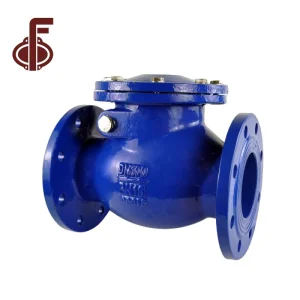
Engineered flange, wafer, and swing check solutions crafted for municipal networks, maritime bunkering, and corrosive fluid lines.
Initiate Your Custom Valve Procurement Project
Whether you require tender-ready datasheets, 3D CAD step models for piping clash analysis, or comprehensive pricing for full container loads of wafer, lug, or triple offset butterfly valves, Tianjin Zhongfa Valve Co., Ltd. delivers engineered certainty within 24 hours.
